in Geneva, which it turns out, isn't a place I am all that fond of. But, for those curious, here's a tentative itinerary for this round of adventure.
June 2nd-7th: Tbilisi
June 7th-9th: Tkibuli
June 9th-21st: Pankisi
June 22nd - July 3rd: Mestia
July 3rd-6th: Sighnaghi
July 7th-9th: Istanbul
July 9th-12th: Trabzon
July 12th-13th: Batumi
July 13th-August 1st: Mestia
August 1st-2nd: Tbilisi
August 2nd-9th: Chambery
August 9th: NYC
Showing posts with label georgia. Show all posts
Showing posts with label georgia. Show all posts
Saturday, June 01, 2013


Tuesday, August 07, 2012
We Were Searching For Ourselves in Each Other

It’s
July 2010, and everyone is balmy in New York. I just moved into a huge
apartment in Harlem with four guys I met under a year ago, and we still don’t
have a couch. It’s a Saturday afternoon. Two of us are home, trying to read
without dripping too much sweat on the pages. The Anthology Film Archives
calendar sits on a stool. Desperate to get out, I flip through it. Sergei
Paradjanov. The Color of Pomegranates (1968). July 17: 7:15 pm. I know I’d heard
the name before, and recall my aunt having a large illustrated volume with one
word on the cover: Paradjanov. This seems reassuring enough.
I awkwardly show
the calendar to my roommate. I am not sure exactly how much we have in common.
We decide to go. If anything, we can get Indian at Punjabi Deli afterwards. We
are about ten minutes late.
A
child dangles off a clock’s pendulum with an expression of amused stoicism on
his face. The same child, a depiction of the eighteenth century troubadour poet
Sayat Nova in his young age, climbs up a ladder to a roof covered in huge
drying books. The pages flip and flutter like gigantic moth wings, revealing
illuminated medieval manuscripts. Colored wool is thrown on silver platters,
each drop of pigment loud and clear on the metallic surface.
 My
roommate and I look at each other, and realize that we are infected, even if we
are not sure, not yet anyway, and maybe not ever, what exactly each step of
this wild associative flight means. But we are willing to go with it.
My
roommate and I look at each other, and realize that we are infected, even if we
are not sure, not yet anyway, and maybe not ever, what exactly each step of
this wild associative flight means. But we are willing to go with it. 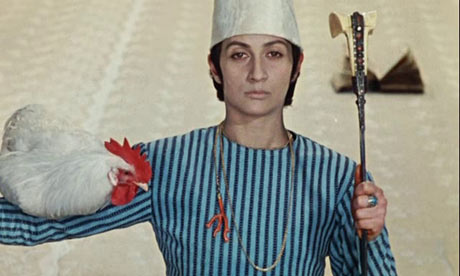 The
rhythm of a loom spinning white and red lace. One of six Sofiko Chiaurelis*
holds a piece of red lace in front of her face. Another, this time male, tunes
a kemenche. We were searching for
ourselves in each other. The muse and the troubadour: sides of the same
specter.
The
rhythm of a loom spinning white and red lace. One of six Sofiko Chiaurelis*
holds a piece of red lace in front of her face. Another, this time male, tunes
a kemenche. We were searching for
ourselves in each other. The muse and the troubadour: sides of the same
specter. 
What
is this we are watching? How does it come together? Where can it take place? It
is July 2010, but we’re in 18th century dream-world Caucasus; it
holds together because of the man whose inner world it strives to present and
the man who presents it, unabashedly, confidently, in a frenzy that flows
slowly and beautifully like the fabrics on the screen.
Sayat
Nova (an adopted name that means “Master of Songs” in Persian), a celebrated
troubadour (ashik), lived on the territory of Armenia and Georgia. Born in
Tbilisi (akaTiflis). He composed hundreds of songs in Azerbaijani, Armenian,
Georgian and Persian, still sung by traditional performers. Sayat Nova
performed at the Georgian king’s court, and later became an ordained priest. He
died in the Haghpat Monastery in Armenia.
A
group of monks stands on stone steps sucking on pomegranates. They sound like
carnivores. Two monks wash their feet. Two others carry them, piggy-back, to
the grapes they are to start stomping.
Born
in 1924 in Tbilisi, Georgia, to Armenian parents, Sergei Paradjanov grew up in
the same city. He lived there, in the Ukraine, and in Armenia. Paradjanov died
in 1990, making four feature-length movies that are available to the general
public (he considered his early films constricted and bad). He was in the
middle of his final project, titled A
Confession, when he died.
Aroutin chants the screen at a baptism. Some
minutes later the Catholicos (head of Armenian Orthodox church) turns a glowing
blue and falls dead. Sheep flock a small church with a cocktail-umbrella roof.
The protagonist digs a grave.
 Paradjanov
spent years in Gulags, accused of pretty much everything from bribery to
then-illegal in the USSR homosexuality. The
Color of Pomegranates was banned by the Soviet government, and Paradjanov
could not make another film until 1984. While imprisoned, Paradjanov made
drawings, dolls, collages from whatever he could find. When he was released, but
still not allowed to make films, he continued these pursuits. Most of his art,
alongside with some furnishings from his apartment in Tbilisi lives in the
Paradjanov house-museum in Yerevan.
Paradjanov
spent years in Gulags, accused of pretty much everything from bribery to
then-illegal in the USSR homosexuality. The
Color of Pomegranates was banned by the Soviet government, and Paradjanov
could not make another film until 1984. While imprisoned, Paradjanov made
drawings, dolls, collages from whatever he could find. When he was released, but
still not allowed to make films, he continued these pursuits. Most of his art,
alongside with some furnishings from his apartment in Tbilisi lives in the
Paradjanov house-museum in Yerevan.
A
memory of childhood: the young Sayat Nova runs around with lavash bread hanging
from his forearms.
Each
frame is a carefully designed, brilliantly explosive tableau of color and
texture. We want these clothes, we say. We want these sounds. We want a
nautilus shell to cover one breast and not the other.
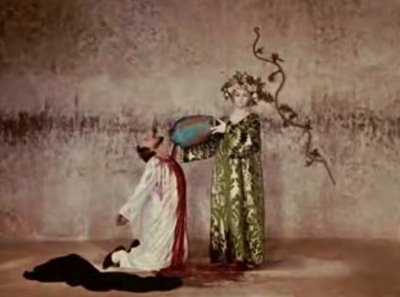
A
final Sofiko stands over the middle-aged Sayat Nova. She wears a lavish green
and gold garment, a wreath crowning her head of blond hair, a rooster perched
on her shoulder, and spills wine onto the chest of the poet, dressed in a white
linen tunic.
When
we get home, we look up everything we can about Paradjanov. I buy The Color of
Pomegranates. We rent Shadows of Our Forgotten Ancestors, his 1964 film set in
the Ukraine, and based on Ukrainian folklore. We steal a DVD with the other two
films, The Legend of Surami Fortress, and Ashik Kerib, from somebody’s house.
We don’t even feel guilty. We watch these films multiple times. I start wearing
brighter clothes, long, flowing, patterned dresses in particular. Everything
both of us know of Armenia and Georgia comes out. We buy books about Paradjanov,
look up people he influenced, was influenced by. My 90-year old Georgian
grandmother gets harassed almost daily for recipes and pronunciation advice. I
get every CD of Georgian and Armenian traditional music I can possibly find.
And yet, this is all not enough: we are sharing an obsession, but no matter
what we read, look at, watch, we are too far away.
Neither
of us has any money, but I’ve got a car. I sell the car. We buy two plane
tickets for November 18th-28th, to Yerevan.
 It
seems nobody has thought this through. Some friends think we’re crazy,
especially me. But we go. And we go to the Paradjanov museum in Yerevan, and
then take a night train to Tbilisi, and amble about with no plan at all, and we
go and meet relatives I have in the town of Tqibuli, and somehow, despite the
fact that neither Georgia nor Armenia are anything like the movie, not now –
and of course we expected this – I am changed by the experience of following
this through. Somehow, this entire journey becomes a Paradjanov movie – less
lavish, less bright and intricate, but I feel something impish in me come out,
something brazen and dedicated. I write poems that could not have happened
before. They are the only ones to get published.
It
seems nobody has thought this through. Some friends think we’re crazy,
especially me. But we go. And we go to the Paradjanov museum in Yerevan, and
then take a night train to Tbilisi, and amble about with no plan at all, and we
go and meet relatives I have in the town of Tqibuli, and somehow, despite the
fact that neither Georgia nor Armenia are anything like the movie, not now –
and of course we expected this – I am changed by the experience of following
this through. Somehow, this entire journey becomes a Paradjanov movie – less
lavish, less bright and intricate, but I feel something impish in me come out,
something brazen and dedicated. I write poems that could not have happened
before. They are the only ones to get published.
I
wonder if this is just a phase. After all, a movie is a movie. A director,
however influential and insane, is a director. A year goes by. Both of us move
out of the apartment in Harlem, to different boroughs. I spend my summer in a
tent in Transylvania, digging up potsherds. I come back and go to the Russian
store on 181st street and meet a woman who works there, who was Paradjanov’s
neighbor in Tbilisi; this woman has my name. And it is clear that this is not
going anywhere. No place, no person has grown more true.
In
November 2011, I find myself applying to PhD programs in Anthropology to focus
on the Caucasus. This hardly follows a 2-year-old MFA in Poetry. I cannot
possibly get in, I think. To get myself through the waiting game, my now former
roommate and I start subtitling an old (Soviet) Georgian film, co-starring
Paradjanov’s favorite Sofiko Chiaureli.
In
midwinter, I find three prints I’d bought and forgotten all about in a notebook:
two stills from Pomegranates, and a
photo of Paradjanov himself. I take that as a good sign. I am right to.

It’s
true, of course, that Armenia has claimed Paradjanov more so than Georgia has,
and my focus, in the end, is the latter. But that’s not the point here:
Paradjanov's films take the collective mythology of the Caucasus and bring it
alive, without drawing borders. I think of the patterns, colors, music,
language in these movies, and realize that all this was around me for years,
since birth perhaps. But it took Paradjanov to wake me up to it. He has that
effect on people, it seems, the effect of bringing out the origins, the
mixtures we are all composed of, the imagination we had as children and perhaps
have repressed. His films show that it is not at all a necessity to stick to
some accepted notion of adulthood at all times. He gives us the time not to.
I
may be naïve to place so much significance on one Saturday afternoon, on one
film, on one dead man, but I will take naivety, if it rids me of staleness.
White
doves flutter and flip over lit candles on a stone floor of a cellar. A mason
finishes one of the walls. Sayat Nova stands in the cellar. Sing! Sing! says the mason. Sing! Sing! Die, he says.
* Sofiko Chiaureli was a famous Georgian actress; she appeared in
three of Paradjanov’s films.
Saturday, February 25, 2012
It's been a long, long, long time.
It is perhaps time for a revival. Though my blogging skills remain basic at best, I have got to get back into the habit, at least somewhat. I have my summer journey mostly planned out. It will look like this:
View Summer 2012 in a larger map
New York ---> Tbilisi ---> Zugdidi ---> Mestia, Svaneti; I will be helping at Nino's Guesthouse ---> Zugdidi ---> Tbilisi ---> New York
Dates: May 11th - July 3rd.
View Summer 2012 in a larger map
New York ---> Tbilisi ---> Zugdidi ---> Mestia, Svaneti; I will be helping at Nino's Guesthouse ---> Zugdidi ---> Tbilisi ---> New York
Dates: May 11th - July 3rd.
Tuesday, September 27, 2011
GRE ---> check.
PhD school in Georgians is becoming more and more of a thing.
I am writing a statement of purpose, even.
I am also a librarian now.
This is, to me, unsettling. In fact, I am hoping to go there and see what is happening because, apparently, Saakashvili is trying to make Svaneti a super tourist destination. This is bound to bring forth significant, probably irreversible changes. I am refraining from a value judgment. I just want to get there.
It is always scary to me, inevitably scary, when roads get constructed, hotels built, people shipped over for an exotic time in a remote part of the world. Why are we to simplify everything so much that so little authenticity remains? Why must we put our comfort above all else? Why must we be fine flying for ten hours, only to desire the same commodities as our homes provide, the same foods, air, drinks... how many times have I seen this happen? It will never stop, will it?
Project coming along. Should be done in something like two weeks.
PhD school in Georgians is becoming more and more of a thing.
I am writing a statement of purpose, even.
I am also a librarian now.
This is, to me, unsettling. In fact, I am hoping to go there and see what is happening because, apparently, Saakashvili is trying to make Svaneti a super tourist destination. This is bound to bring forth significant, probably irreversible changes. I am refraining from a value judgment. I just want to get there.
It is always scary to me, inevitably scary, when roads get constructed, hotels built, people shipped over for an exotic time in a remote part of the world. Why are we to simplify everything so much that so little authenticity remains? Why must we put our comfort above all else? Why must we be fine flying for ten hours, only to desire the same commodities as our homes provide, the same foods, air, drinks... how many times have I seen this happen? It will never stop, will it?
Project coming along. Should be done in something like two weeks.
Friday, May 13, 2011
Dancing with the Urinals
When we were in the one-car train going from Tq'ibuli to Kutaisi, at one point, this was on the unexpected TV screen right in front of us. I am not actually sure what to say, still, even though it's been a few months.
Sunday, May 08, 2011
Ten
Ten days before I leave. There is now a whole separate page with my Georgia/Armenia travel journal, in case anyone was curious. It's still incomplete, but one has to start somewhere.
In the context of my impending project, I've been thinking a lot about the big bad guy I used to inhabit, also known as mother Russia, or "the old country". I realize that I am going to places that were tyrannized, partnered with or heavily influenced by that entity for quite a while, and looking at them twenty years after the whole thing went kaput, but from a weird perspective: I am a briefly-baptized-but-in-denial-about-it Russian [ethnic] Jew (even if I hardly practice the religion, my birth certificate says "Jew" under nationality... what sense it makes, I do not know, but it certainly makes it hard to assume a new national identity) who only encountered four years of the old regime (on its way out, at that), witnessed two currency reforms, watched the feeble attempts at privatization and erm, democracy come, nearly bloom, and quickly wilt, and got the hell out before darling Putin really "tsared" himself up, only to end up in another hegemonic landscape, which is just as heavily despised. And here I am now. Visiting the periphery. Watching places like Georgia slowly but surely take Russian out of practice. I can't blame them (even it makes it harder for me to get around). I just wish, sometimes, that I didn't come from a despot-land.
In the context of my impending project, I've been thinking a lot about the big bad guy I used to inhabit, also known as mother Russia, or "the old country". I realize that I am going to places that were tyrannized, partnered with or heavily influenced by that entity for quite a while, and looking at them twenty years after the whole thing went kaput, but from a weird perspective: I am a briefly-baptized-but-in-denial-about-it Russian [ethnic] Jew (even if I hardly practice the religion, my birth certificate says "Jew" under nationality... what sense it makes, I do not know, but it certainly makes it hard to assume a new national identity) who only encountered four years of the old regime (on its way out, at that), witnessed two currency reforms, watched the feeble attempts at privatization and erm, democracy come, nearly bloom, and quickly wilt, and got the hell out before darling Putin really "tsared" himself up, only to end up in another hegemonic landscape, which is just as heavily despised. And here I am now. Visiting the periphery. Watching places like Georgia slowly but surely take Russian out of practice. I can't blame them (even it makes it harder for me to get around). I just wish, sometimes, that I didn't come from a despot-land.
Friday, January 14, 2011
Tbilisi: the rundown capital


Something about the colors in Tbilisi suggests both a decline and a sort of refreshing morning dew.


Thursday, January 13, 2011




Sunday, December 12, 2010
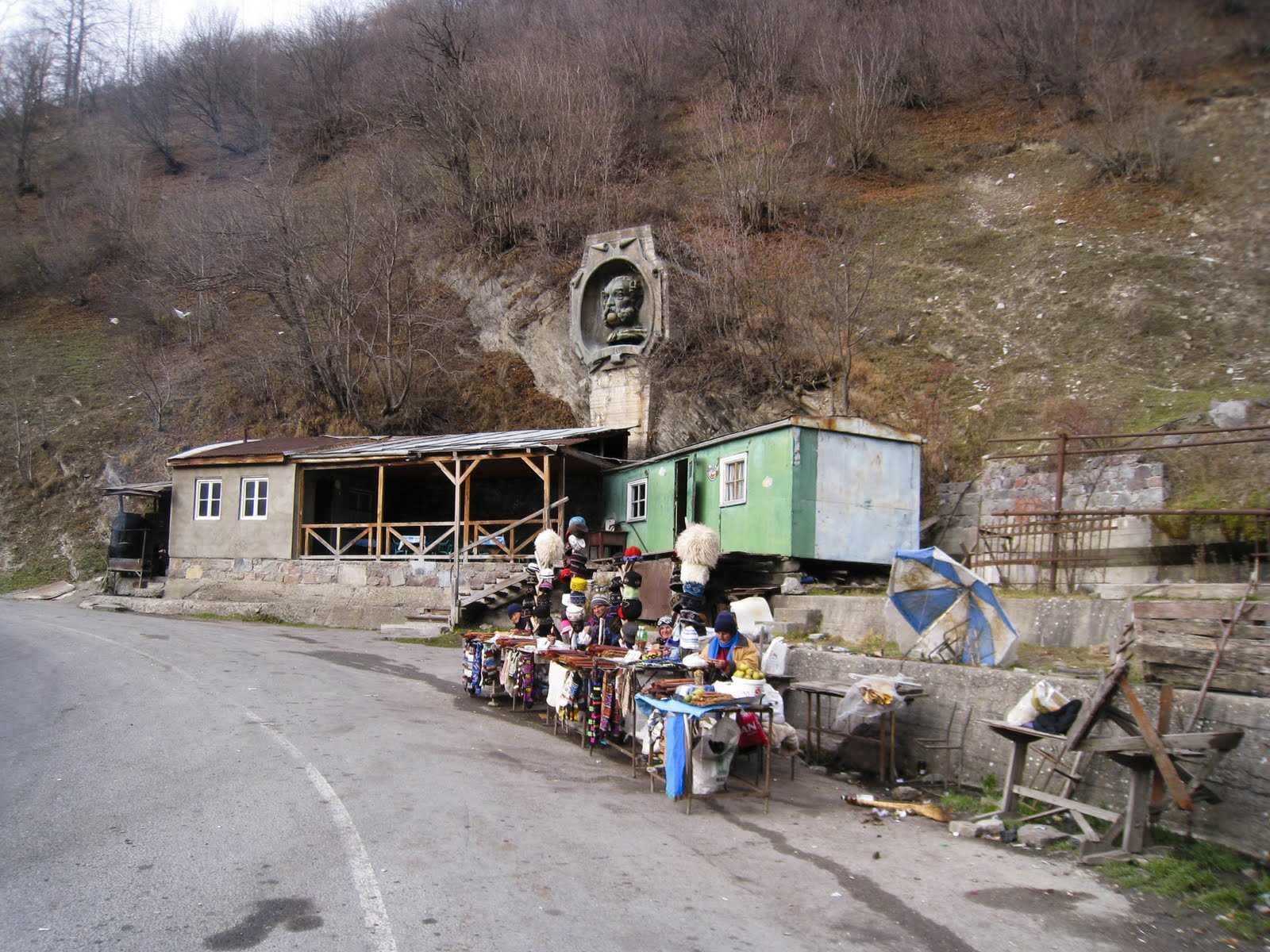
T'q'ibuli


Yes, those bricks really are necessary.


Sometimes, you forget what century you are in until you see a satellite dish.
Subscribe to:
Posts (Atom)